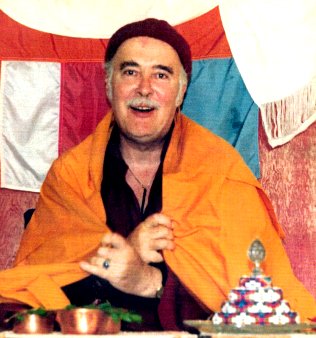
Namgyal
Rinpoche on Fees & Trust at The Dharma Centre
Epilogue
to his Discourse on The Forest Grove Vanapattha Sutta
3pm - April 1 - 1991
At minute 23:00
And that's the discourse on the Forest Grove - the seventh
actually, the seventh discourse on the Forest Grove.
Don't know where the other six are. So that's it! May
you be well and happy! "Sabbe sutta sukhita hontu".
And it's for you to work it out, it's your salvation
- you know, work out your salvation with diligence.
What can you do about it? Now, begin to ponder.
By
the way, if you have very bad people - they're part
of the environment. The Buddha said not to associate
with fools you know so drop it - it's a great blessing
if you learn to break that one. These people - let's
put it in simple language - these people bring me down
- and they lead me astray; you know, when they put that
pressure on, you know, the emotional blackmail, they
do little things which are not correct - DROP IT! -
As part of your environment. If a person, however, is
not bringing you down, if in fact they are supportive
in a way - take a bit of flack from them - but sort
it out.
If
you could only just sit down and sort of think…
Now this is why I get so concerned about the Dharma
Centre in Kinmount. Do you hear me? And why? Because
it's supposed to be an environment for people, of Refuge!
Not that the people there indulge themselves to the
point where the person loses - people who come lose
creativity possibly; lose serenity; don't feel the sense
of freedom; don't feel that their defilements…
And sometimes feel that the defilements are increasing,
by getting embroiled in internecine or you know what
I mean - or petty numbers.
And
certainly I hope that the Dharma Centre doesn't give
them that feeling that they can't afford to go there!
That needs to be said too. That's under the necessities
of life. Ideally, what we would like for the Dharma
Centre, is not a price tag on everything, but that people
who genuinely want to unfold, are free to go there,
and cover - you know what I mean - the bare necessities
that exist for the path, and get on with it - and not
feel they have to worry, worry, worry, worry, worry
about the financial level!
Because
that puts a block on the spiritual development, we know
that… we have to be a bit, sort of, pragmatic.
I think someone who, possibly, hasn't got much to get
by with, has to be sort of encouraged to feel that they
can go there - and hopefully they'll just sort of live
in a kind of 'The Lord will provide' kind of thing -
and hope that other people will take up the slack for
them. We live in a pragmatic world too, but it's a feeling
that you have to remove - to give a sense of freedom
to the being. It's a very important point, very important!
Q.
Is there any way that some kind of specific guideline
could be given to the Dharma Centre to allow that?
Well, I think they do have it, but people don't trust
it. You see, anything happening at the Dharma Centre,
as far as I understand it - and I'm not responsible
for the Dharma Centre, the Board of Directors are -
I want to make that very, very clear - should be only
guidelines. It costs so much to house and feed, and
there are bills. So I think people - may I say, can
know that - but as far as I know, they write it out;
that if you cannot do that - and maybe that should be
even more emphasized - if you can't do that, please,
come, anyway! We invite you to come anyway, if you're
a genuine aspirer! And that feeling should be given
to people, so that the criterion of money is only a
guideline and not a demand from the being.
Q.
Is that the actual?
It's
up to the karma of the being to work it out whether
they are just flopping on others, or whether they are
genuinely short - short-changed. What do we want? We
don't want the money - we want the unfolded beings to
transform the society! That's what we want.
It
does raise the question - with some people, not with
all people who genuinely want to come - but some people
who never think in terms of other people, that there
are bills. You understand what I mean - they don't think
'well, there are bills - how do you run this place?'
And it's for self-respect of the being; I believe it
is very important for people to give Dana, because then
they think 'I am participating; I'm not just taking,
I'm giving'.
Now
please take that, under advice, that this can mean I'm,
you know, the Widow's Mite … I'm doing the best
I can with that level …
Jesus
praised - and you know, so did the Buddha too - Jesus
praised - there were people who came and gave a lot
of money, and the wealthy merchants and so on, to the
support of that ministry at that time - and then there
was someone else who was just a widow - she came up
and she put in the temple coffers two pence - and Jesus
praised, because that was more a sacrifice actually
for her than other people who would just toss off this
or that amount, and all the rest of it.
So,
I think teachings about money should be given. The Order
and the - (if it could work), the Dharma Centre should
work only on Dana - as in pure theory - should work
only on gifts! Therefore, they can never charge anything.
They
can suggest; discreetly, reverently, respectfully, to
beings - the lay out; 'this is approximately what it
costs to feed and house beings'. And put it as a question,
'What can you do?' Not 'oh well you can't attend this
course because it costs x numbers of dollars'!
Q.
Well that has been the impression a lot of times
in the past.
Yes,
but it's not there! It should not - I mean please, I'm
not that directly involved, I'm guiltless, I'm really
truly out of it - what goes on - what they do. But I
thought that it was written out fairly clearly - and
you can at least draw the attention of the being; there's
a paragraph that says 'if you haven't got it for some
reason, do the best you can. That's all'.
The
principle of Dana, which is 'free giving', transcends
- if you practice according to the East you do not say
'this course costs so much'! You can only say, 'we would
like to raise this much per person', and so on.
Now
I want to tell you, myself - this is a personal thing.
I give courses; I never get - never, never, never, get
- the theoretic amount, that if you counted the heads
of beings - (you know, as they suggested) -30 people
meditate, and they suggest an amount - let's say, whatever
it is - if its $100 per head, it never works out that
way. Because there are other people in the Order, there
are people who simply haven't got it because they maybe
have children responsibilities, etc. The guidelines
are not met. I'm just stating a fact. And I'm sure for
the Dharma Centre, the guidelines are not met. There
are people who come forth and behind the scenes - fill
in. This is the actuality. So please don't think that
either I or the Dharma Centre get the - I mean, you
know - if you just sat down and said: 'oh, so many people
came and they all paid and everything's 'hunkey dorey'.
It doesn't work like that. There are quite a number
of people who take, sometimes, direct advantage, that
there isn't a bill, and you know, some people trade
on it. People do all sorts of numbers…
But
does that help you a bit? If you see some guideline
which is something or other, you can - if you are good-hearted
- ignore it. I wish they would stress that - and possibly
they do. But people have a great deal of distrust, I
think, at the money level anyway, and they are likely
to ascribe motivations to the Board and to the technical
staff, which aren't actually there. They say 'oh, I
haven't got it' and they feel guilty. It's not the money
you've got to have; it's the good heart for development!
[Pause] Put that in the box.
However,
it is very important - extremely important - a point
which you can not ignore - that you must be a giver
and not just a taker. That's the beginning of maturity
and liberation - 'I feel good! I don't necessarily have
money, but I feel I give work, or energy, or I give
- you understand, support to people, or I move a few
plates around'. Or, you know what I mean?
You
know that (movie) Little Shop of Horrors? I sometimes
see the Dharma Centre as a Little Shop of Horrors, you
know. Do you know that one? Who's seen it? Do you know
that one? You haven't seen it? Oh you've got to see
it. These flowers that keep growing and growing and
growing? [low voice] Feeeed me, feeeed me… All
those little flowers in the room? - feeeed me, feeeed
me…
But
of course, the point is, you wouldn't be able to digest
the food unless you felt that you were feeding - in
some way or other, you feel at home with that. Unfortunately,
people have a lot of guilt about money. Bear that in
mind. It's a very difficult area for people, and they
worry, worry - and that's what I'm pointing out. You've
got to transcend that; you've got to drop the worry
about money.
Jesus
again - 'take no thought for the 'morrow'. Don't get
so het up about the money level, and then your attendance;
whether you've got it or you haven't got it, right?
I
just speak personally; I don't even worry if someone
doesn't give. I worry for them! Can you hear that? Not
the amount, but I wonder - I just wonder; and I certainly
would wonder if someone had a lot of money and didn't
give, wouldn't you Wouldn't you, if you knew someone
who was very wealthy? And by the way, I'd like to point
out that the wealthy people are extremely stingy - very
frequently, are very stingy. [Long Pause]
How
do you think they got to be so rich? [laughter]
I
went on the alms round in - I want to share these ideas
with you - maybe it will clear up where 'my' mind is,
it might help you. I went on the alms round in Sri Lanka,
and you know the down of the down are the Tamils; you
know that there is sort of a revolt happening, and the
Tamils have the revolutionary army or whatever it is
they are trying to do - but the Tamils are the down
people and the Sinhalese are the up people in Sri Lanka.
And I went on the alms round, and I did receive food
from Sri Lankans in prosperous houses, through the alms
bowl, going through the village. And I go to the other
side of the village, and the alms bowl is full - and
I'm not supposed to have it overflowing - so I'll go
back. Just as I was going back a Tamil woman, who was
relatively poor actually, very poor, very simply dressed
- a very simple sari - there was no money around, right?
Barefoot children, naked children running around in
the mud and the house which wasn't too glorious and
all the rest of it - and very obviously you knew in
a moment that this woman was just barely surviving -
and she motioned, to give, she wanted to give! Place
in the alms bowl - and she only had rice to give. She
didn't have fine meats and 'viands'. Well mostly, they
have vegetarian food - so she didn't have any of the
fine things, but she had a lot of rice. And she started
to pack the bowl. And she packed, and she packed, and
she packed the bowl! She was the most generous person
in regard to what she had - the ratio of what she had.
And the bowl - the food was dripping over the side and
you're not supposed to do that! Bad, bad monk! I kept
saying, 'tikka, tikka', which means, little, little.
So she kept packing the bowl and I had to go back to
the monastery with this bowl and it was disgraceful.
It's a big bowl and it was full. And I was obviously
being greedy. The Abbot called me in. He said, 'are
you aware of the rules, that you're not supposed to
have the bowl full? 'Amah Bhante'. I did not do it consciously
- not I, not I - a very Buddhist answer. I gave an explanation
that because of the language and the woman not knowing
the rule - she didn't break the rule and I didn't break
the rule…
But
in my experience, in my experience, it is the - per
ratio - it's the people who haven't got, who are the
most generous! And the people who do have - well, that's
how they got to have! I think that's basically what
it is.
I've
seen people - and I've seen the change in their life
- I've seen people around the Dharma Centre, as soon
as they became financially wealthy - depart; just go
off - into the woodwork - just dropped any respect or
any appreciation for the teaching that they received.
They just got some money, they got lucky, anyway; they
went, and that's the last we heard of them. Sold this
or that, or bought a house or got a hundred or two hundred
thousand, and so on.
What
did they take off for? To do meditation - to develop
new creative dimensions? Well, maybe. To develop serenity?
No. To develop liberation from defilements? No. To develop
a sense of - well, I guess a sense of freedom - if you
consider that taking off for say, Mexico and smoking
pot is freedom, right? You know, they gave up the whole
idea of the holy life. So I guess one of the motivations
for the holy life is also poverty! The Buddha said that
in life, if you get too rich, you lack motivation; if
you are too poor, you lack opportunity. Somewhere in
the Middle Way, there is a possibility. So, that's what
it is. May you be well and happy!
I
wanted to share these personal ideas with you.
Did
you record any of this today?
A:
I did sir; if you want, I'll erase the tape…
Oh
no, no, no, not at all - I don't want it erased, why
not - It's a Statement of Truth!
Download
a PDF version of this
Back